This paper was recently published in Journal of Cognition
This work was led by Dr Lena Blott, who recently left the lab to take up a position at the University of Mannheim
Researching the Wonders of Words
This paper was recently published in Journal of Cognition
This work was led by Dr Lena Blott, who recently left the lab to take up a position at the University of Mannheim
This paper recently came out in Psychonomic Bulletin & Review
This work was led By Dr Rachael Hulme, who has very recently moved to a lectureship at Herriot Watt University.
This paper came out in Journal of Experimental Psychology: General
It was led by Dr Matthew Mak, based at the University of York.
This work explores how we track and adjust our knowledge about word meanings as instances of a word are encountered, with particular focus on the role of sleep in this process. In Experiment 1, participants encountered low-ambiguity words (e.g., bathtub) in sentences that biased their meanings towards a specific interpretation (e.g., bathtub-slip vs. bathtub-relax). In Experiment 2, participants encountered word-class ambiguous words (e.g., loan) in sentences where the words were used in their dispreferred word class (e.g., “He will loan me money”). Both experiments showed that such sentential experience influenced later interpretation and usage of the words more after a night’s sleep than a day awake
We interpret these results as evidence for a general role of episodic memory in language comprehension such that new episodic memories are formed every time a sentence is comprehended, and these memories contribute to lexical processing next time the word is encountered, as well as potentially to the fine-tuning of long-term lexical knowledge.
This paper has just come out in the Quarterly Journal of Experimental Psychology.
The research was led by Rebecca Norman, a PhD student in the lab who is co-supervised by Jo Taylor and Jenni Rodd.

From mid-childhood onwards, most new words are learned through reading. The precise meaning of many words depends upon the linguistic context in which they are encountered, which readers use to infer the appropriate interpretation. However, it is unclear what features of these linguistic contexts best support learning of new word meanings. We investigated whether learning words in contextually diverse sentences benefits word form and meaning learning in adults (n = 239). Participants learned meanings for 8 pseudowords through reading 10 sentences about each. Four pseudowords were learned in a diverse condition (10 sentences on different topics) and four were learned in a non-diverse condition (10 sentences on the same topic). An old-new decision post-test indicated that diversity did not influence word form learning. In a second post-test, participants chose which trained pseudoword completed a sentence from either an unfamiliar, untrained context, or a familiar, trained context. For familiar contexts, accuracy was higher for pseudowords learned in the non-diverse condition, but for unfamiliar contexts, accuracy was higher for pseudowords learned in the diverse condition. These results suggest that diverse contexts may promote development of flexible, decontextualised meaning representations that are easier to generalise to new contexts. Conversely, non-diverse contexts may favour extraction of context-bound representations that are more easily used in the same context.
Lena Blott and Jennifer Rodd have published a new paper together with undergraduate researcher Oliver Hartopp and Professor Kate Nation from the University of Oxford.

The paper can be accessed here.
Previous work from the Word Lab has demonstrated that we can prime people such that relatively infrequent meanings of ambiguous words (e.g. the “animal enclosure” meaning of “pen”) become temporarily more readily available. This has been termed “word-meaning priming” (see e.g. Betts et al., 2018; Gilbert et al., 2018; Rodd et al., 2013; Rodd et al., 2016).
For the present experiment, we designed our priming stimuli to be short narratives in which cues to disambiguation were relatively weak, and distant from the ambiguous word itself. We replicated the previously observed word-meaning priming effect with these stimuli, which are, arguably, more naturalistic than the types of sentences typically used in psycholinguistics studies. We hope that this experiment can be a step towards using more naturalistic and varied forms of disambiguation to study how comprehenders can flexibly update their lexical knowledge to aid comprehension.
The study was preregistered. Data and code are available here.

Rachael Hulme and Jenni Rodd looked at how adults integrate new word meanings with existing knowledge when learning new homonyms (e.g. internet-related meaning of “troll”).
link to preprint: https://psyarxiv.com/9fpua
They were interetested in whether sleep plays a role as has previously shown for learning new word forms (e.g. “cathedruke”).
In two experiments adults learned new fictional meanings for low-ambiguity words (e.g., “foam”) through naturalistic story reading. Their memory for the new meanings was tested after 12hrs either including or not including overnight sleep.
They found that a 12hr period including sleep led to better recall and recognition of new word meanings than 12hrs awake. This sleep benefit was specific to when sleep occurred immediately between learning and test, without any extended period of wake in-between. They did not find direct evidence of an active benefit of sleep for consolidating memories of new word meanings; the sleep benefit could be due to the absence of interference from other linguistic input while asleep.
Expt 2 was preregistered, and all materials, data & analysis code are available via the OSF: https://osf.io/m3pj6
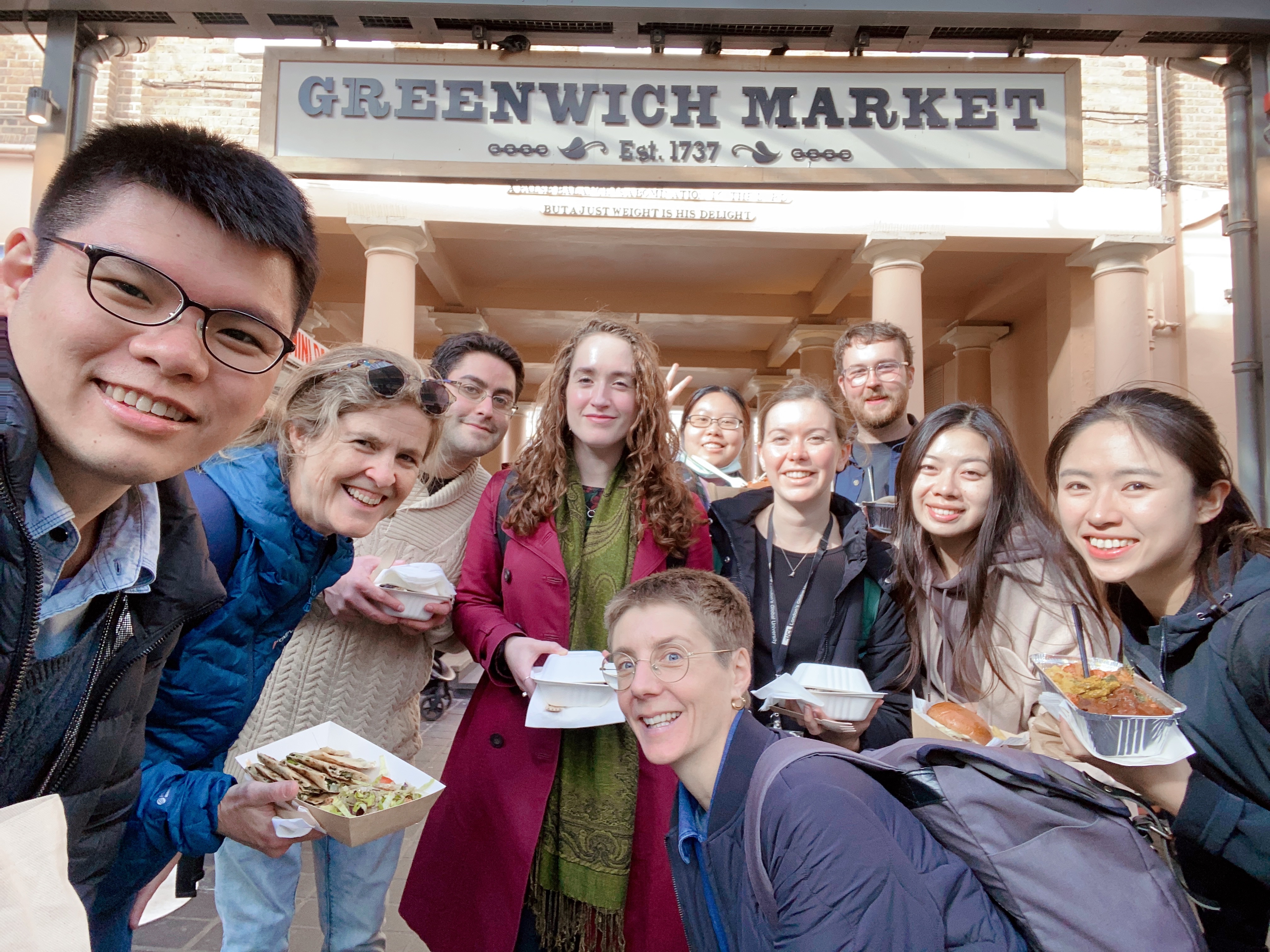
On Po-Heng (Bobby) Chen’s last day in the UK before returning to complete his PhD at National University Taiwan, we went on an outing to Greenwich.
We got the boat down from Embankment before eating food from Greenwich Market in the park. We then walked to admire the view from the top of the hill and visited the Painted Hall, which turned out to have some super freaky visual illusions – legs, eyes and brackets that appear to move as you walk around the room. A great day was had by all. Bobby – we’re going to miss you!



A new preprint By Rachael Hulme, Anisha Begum, Kate Nation and Jenni Rodd looks at how contextual diversity affects early stages of word learning.
Diversity of narrative context disrupts the early stage of learning the meanings of novel words
There’s an important distinction between ‘situational diversity’ (i.e. the context in which words occur) and ‘heterogeneity’ (i.e. polysemy/diversity in words’ meanings). These typically co-occur in natural language, so we wanted to tease contextual diversity apart from polysemy.
Adults learned new words and their meanings by reading paragraphs with either five different narrative contexts or a single coherent narrative context. We controlled the semantic features of word meanings across conditions to avoid influences from polysemy.
Diversity of narrative context did not affect word-form learning but disrupted learning of word meanings – more semantic features were correctly recalled for words learned in a single coherent narrative context.
So in the early stages of learning meanings of new words, learning is boosted by anchoring them to a single coherent narrative discourse. The temporary representations that are built to support discourse comprehension may play an important role in supporting word learning.
The expt was preregistered, and materials, data & analysis code are available via OSF: https://osf.io/2bnw3
Here’s a poster summary of this research: https://bit.ly/3qZ7BSo
This priming study was led by Dr Eva Poort, looking at how very recent experience with words (including cognates and interlingual homographs) in the L2 of Dutch-English bilinguals influenced their processing of related words in their L1.

Poort, E. D, & Rodd, J. M. (2022). Cross-lingual priming of cognates and interlingual homographs from L2 to L1. Glossa Psycholinguistics, 1(1). http://dx.doi.org/10.5070/G601147
This work follows up earlier work by Eva on this topic:
Poort, E.D., Rodd, J.M. (2019). Towards a distributed connectionist account of cognates and interlingual homographs: evidence from semantic relatedness tasks. PeerJ. 7:e6725 https://doi.org/10.7717/peerj.6725
Poort, E. D., & Rodd, J. M. (2017). The cognate facilitation effect in bilingual lexical decision is influenced by stimulus list composition. Acta Psychologica, 180, 52-63. https://doi.org/10.1016/j.actpsy.2017.08.008
Poort, E. D., Warren, J. E.,& Rodd, J. M. (2016). Recent experience with cognates and interlingual homographs in one language affects subsequent processing in another language. Bilingualism: Language and Cognition, 19 (1), 206-212.
Most of the lab travelled to France for their first non-UK conference for several years.
Talks were given by César Gutiérrez, Rebecca Norman, Rachael Hulme and Jenni Rodd on a range of topics related to language learning and processing. Posters were presented by Lena Blott and Rachael Hulme. For full details see here.

 The Word Lab at UCL